
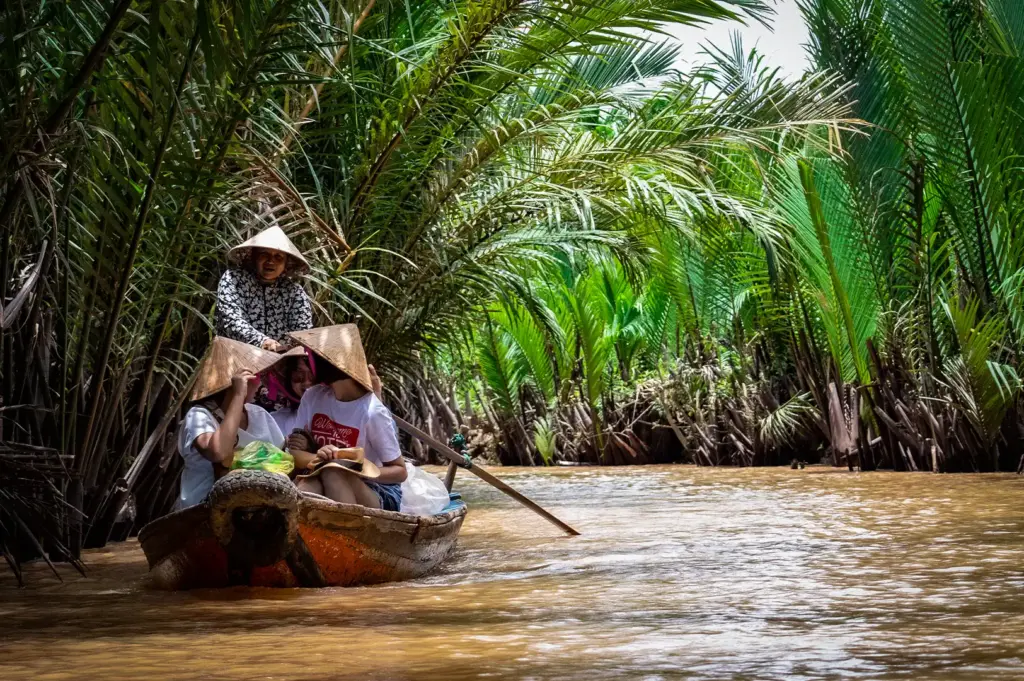
There is something different about travelling through a place shaped by a river.
The river is never simply scenery; it influences where people live, how they move, what they eat, and how they experience the passing day. In Luang Prabang, the Mekong is impossible to separate from the experience of being there. The Nam Khan joins it near the old town, creating a landscape where water, temples, neighbourhoods and mountains seem to exist within the same rhythm.
For a traveler from Singapore, this can feel wonderfully unfamiliar. We are used to cities where movement is defined by roads, trains and timetables, while in Luang Prabang, the river encourages you to think about time differently. You do not need to spend your entire day beside it or turn every moment by the water into an activity. You simply allow the river to become part of the way you experience the town.
Perhaps you begin with a walk along the riverfront in the morning, when the Mekong is quieter than the streets around the main tourist areas. Boats move along the water, people begin their day, and the surrounding hills create a backdrop that changes as the light moves.
There is no obvious reason to hurry, and that is precisely the point.
You can stop to watch the river, continue walking, and pause again when something catches your attention.
This kind of movement is central to slow travel because the journey is not simply a means of reaching the next activity. The journey becomes the activity. Instead of measuring the morning by how many places you have managed to see, you begin to experience the walk itself as part of your time in Luang Prabang.
The rivers also give you a different perspective of the landscape.
A boat journey can become less about getting somewhere and more about watching the world move at river speed, as the shoreline passes gradually and villages and greenery appear and disappear. The scale of the landscape becomes clearer, and you begin to understand why the Mekong is not simply an attraction for visitors but part of a much larger way of life across Laos.
That is an important distinction.
When we travel, it is easy to turn everything into an experience designed for us: a sunset, a boat ride, a riverside dinner, or a photograph. But slow travel asks you to look beyond the moment itself. What role does this river play for the people who live here? How does it shape the landscape? Why have communities developed along it? What does it mean for a town like Luang Prabang to exist at the meeting point of two rivers?
You do not need to answer all these questions during your holiday. Simply noticing them changes the way you see the place. The river becomes more than something beautiful to photograph; it becomes part of the context through which you understand the town.
The Mekong also creates one of the simplest pleasures in Luang Prabang: walking without an agenda.
For Singaporeans, this can be surprisingly liberating because at home, walking usually has a purpose. You are walking to the MRT, walking to lunch, walking to a meeting, or even walking because your watch says you need more steps.
In Luang Prabang, you can walk simply because the river is there.
The old town gives you opportunities to move between the Mekong and Nam Khan, through streets where temples, homes, cafés and guesthouses sit close together. The distances are manageable, but the temptation is to see how much you can cover.
Instead, choose one direction and allow yourself to notice the architecture, look at the river, find somewhere to sit, and continue again when you feel like it. The absence of urgency is what makes the experience memorable.
The river also changes how you experience the end of the day. As afternoon fades, the light softens, the heat becomes easier to bear, and the river takes on another character. This is a good time to stop trying to accomplish anything. Find somewhere by the water, have a drink, share a meal, watch boats moving across the river, and listen to the sounds around you. You may find yourself thinking about how different this feels from a typical holiday.
There is no major attraction to complete, no queue to beat, and no perfect moment you need to capture. You are simply there while the day changes.
That sense of being present is part of what makes Luang Prabang particularly interesting for slow travellers, because the town does not need to compete with the river, the river does not need to compete with the temples, and the temples do not need to compete with the food.
Everything exists together.
A morning can belong to the old town, an afternoon can unfold beside the water, and an evening can return you to the same riverfront street. The destination begins to feel connected rather than divided into separate attractions. Instead of moving from one highlight to another, you begin to experience Luang Prabang as a place with its own rhythm, where different parts of the day naturally lead into one another.
And perhaps that is the most memorable thing about experiencing Luang Prabang slowly. The river teaches you something without asking you to learn it: you do not have to rush simply because the day is passing. The Mekong keeps moving, the light changes, the boats continue, and the town carries on, while you are allowed to move at your own pace within it.
That is the kind of travel memory that stays with you, not because you saw everything, but because, for a few days, you learned how to let a place set the pace. If you want to explore Laos, Luang Prabang in more detail you can check out this Luang Prabang guide for a slow travel itinerary.





