We have become very good at avoiding waiting.
We check when the train arrives, refresh the restaurant reservation, look for another café while waiting for our table, and check the weather again because the sunset might be delayed. Even on holiday, waiting can feel like something has gone wrong, as though every minute spent doing nothing is a minute taken away from the experience we came for.
For Singaporean travellers, this instinct is understandable. We live in a city where efficiency is part of everyday life, with frequent public transport, convenient services, and information available almost instantly.
We learn to expect things to happen when we want them to, but travelling somewhere else can quickly remind us that the world does not always work at our preferred speed.
A train might be late, a restaurant might take longer than expected, rain might arrive before the sunset, or a bus might not appear immediately. At first, these moments can feel like interruptions, but slow travel offers a different way of looking at them.
Waiting does not have to be time taken away from the journey. Sometimes, waiting is part of the journey.
Think about waiting for a train in Japan. You could spend those minutes checking your phone, looking at the departure board, and counting down until the doors open, or you could take the opportunity to look around.
You might listen to the sounds of the station, watch people moving along the platform, notice the quiet order of the morning, or look at the landscape beyond the tracks. The train will arrive either way, but the difference lies in what you experience while waiting for it.
This is one of the quiet lessons of slow travel: not every minute needs to produce something. We are so accustomed to filling our time with tasks, information, and distractions that doing nothing can feel unfamiliar. Yet some moments do not need to lead to anything else.
Some time can simply be lived.
The same lesson applies to food. Travel can introduce a different rhythm, however, in which a meal takes longer, the kitchen prepares dishes one at a time, and someone at the next table enjoys a conversation without constantly checking the clock.
Suddenly, the waiting has become part of dinner. The meal did not become better because it was slow. You simply became more present because you had time to notice it.
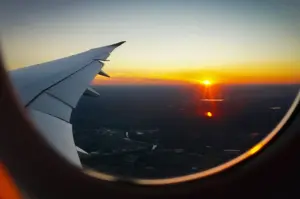
Waiting for a sunset offers another kind of lesson. We often arrive at a viewpoint shortly before the expected golden hour, hoping to see the sky transform at just the right moment. When the light is not quite right, the clouds get in the way, or the colours differ from what we expected, we might check the time, take another photograph, or wonder whether it is worth staying.
The surroundings slowly take on another character, allowing you to experience the transition rather than waiting only for its most photogenic moment. The sunset becomes more than the brief period when the sky turns orange, because the waiting becomes part of what you remember.
Rain can teach the same lesson.
You might have booked an attraction and walked all the way there, only to find that the rain has arrived. The instinct is to find a way around it, but what if you chose somewhere sheltered and waited instead? A café, a small shop, a covered market, or even a train station could offer a different way to spend the afternoon.
Rather than losing time, you might experience the destination from another perspective. Bad weather does not always interrupt the travel experience. Sometimes it creates a different one.
This is where slow travel becomes less about a particular destination and more about a particular mindset. Waiting teaches patience, but it also teaches attention. When there is nothing urgent to do, you begin noticing things that would normally disappear beneath the pressure of the next activity, whether it is a person sitting nearby, a conversation you might otherwise miss, the familiar sounds of a station, or the changing light across a street.
You begin to understand that travel is made up of more than the moments we deliberately plan. The transitions, pauses, delays, and quiet spaces between activities can give a journey its texture, creating experiences that are just as meaningful as the attractions we set out to see.
Slow travel teaches us that time does not always need to be filled to be valuable.
For Singaporean travellers, that can be a surprisingly useful lesson to bring home. We do not need to become slower in everything we do, and efficiency certainly has its place in everyday life. But perhaps we can become a little more comfortable with pauses, whether we are waiting for a friend, waiting for a meal, sitting in a park, watching the rain, or standing on a platform.
There is no requirement to make every minute productive, and sometimes the most meaningful thing we can do is notice that we are waiting and allow ourselves to stay there.
Because travel is not only what happens when we reach the destination. It is also everything that happens while we are getting there, including the moments we might once have dismissed as wasted time.
The slow traveller does not ask, “How can I make the waiting disappear?” They ask, “What can I notice while I wait?”